
Kenya Phone Tax Tracker: The 25% Import Duty, Gazette by Gazette
Article

Steve Owako
Shwari Phones
Last updated: 27 November 2026
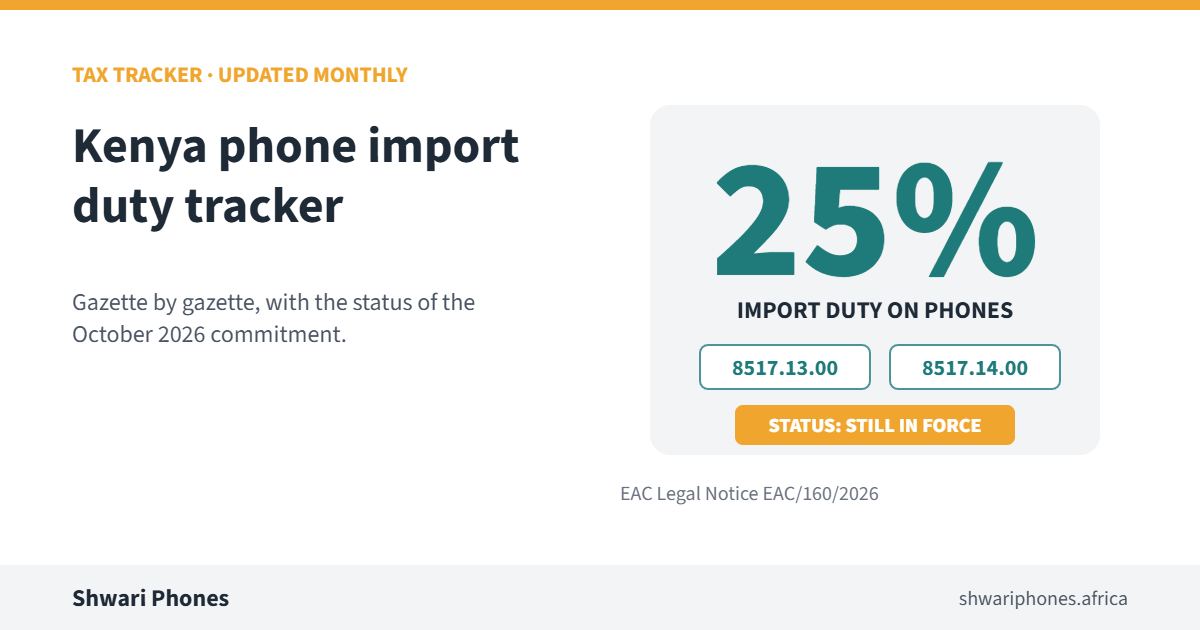
Phone import duty in Kenya is 25% on tariff headings 8517.13.00 (smartphones) and 8517.14.00 (other mobile phones, including feature phones). It applies under EAC Gazette Vol. AT 1 No. 16 of 30 June 2026, Legal Notice EAC/160/2026, for one year from 1 July 2026. On 20 October 2026 President William Ruto said the government would pursue removing it. As of 27 November 2026, the duty has not been removed.
Status at a glance
- Current rate: 25% import duty on 8517.13.00 and 8517.14.00
- Legal basis: EAC Gazette Vol. AT 1 No. 16, 30 June 2026, Legal Notice EAC/160/2026, entry 19
- Runs until: 30 June 2027, unless amended earlier
- Removal announced: Yes, 20 October 2026
- Removal in effect: No
- Last checked: 27 November 2026. Next scheduled check: late December 2026.
This tracker of phone import duty in Kenya records what the law says, what has been proposed and what has happened, with a source for each line. It takes no position on whether the duty should stay or go. Shwari Phones sells imported phones, so we have a commercial interest in phone taxes. That is why every entry below links to a primary or named source you can check yourself.
Contents
How phone import duty in Kenya works
Kenya’s customs tariffs are set at East African Community level, under the EAC Common External Tariff (CET). The CET rate for mobile phones is 0%. A partner state can ask the EAC Council of Ministers for a “stay of application”, which lets it charge a different rate for one year. Kenya has used that mechanism to charge 25% on phones instead of 0%.
Because it is an EAC measure, the rate is published in the EAC Gazette rather than the Kenya Gazette, and it has to be renewed each year. It also means removing it is not only a domestic decision. The President described the step as pursuing the “necessary legal and customs processes”.
| Tariff heading | Description | CET rate | Rate Kenya applies |
|---|---|---|---|
| 8517.13.00 | Smartphones | 0% | 25% |
| 8517.14.00 | Other telephones for cellular or wireless networks (includes feature phones) | 0% | 25% |
Phone import duty in Kenya: gazette history since 2024
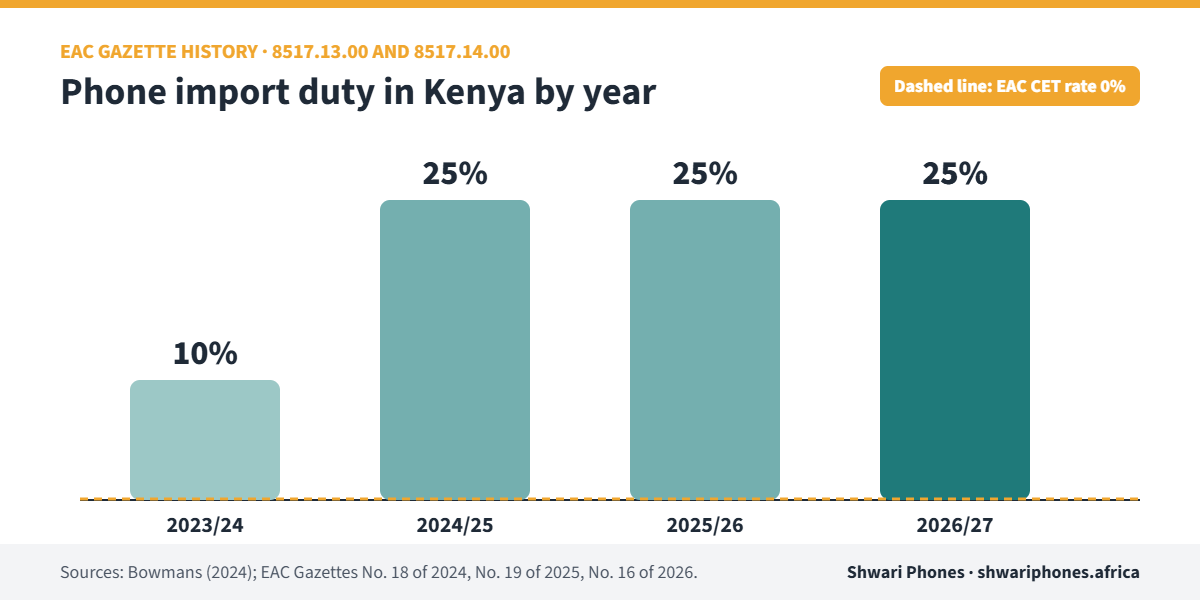
Several summaries of the June 2026 gazette describe phones as moving “from 0% to 25%” on 1 July 2026. That compares the 25% with the CET rate. It does not mean Kenya was charging 0% before July 2026. The gazettes show the 25% stay has been renewed every year since July 2024.
| Period | Rate on 8517.13.00 and 8517.14.00 | Instrument |
|---|---|---|
| Year to 30 June 2024 | 10% | Earlier stay of the 0% CET rate, as summarised by Bowmans |
| 1 July 2024 to 30 June 2025 | 25% | EAC Gazette Vol. AT 1 No. 18, 30 June 2024 |
| 1 July 2025 to 30 June 2026 | 25% | EAC Gazette Vol. AT 1 No. 19, 30 June 2025, Legal Notice EAC/171/2025, entry 18 |
| 1 July 2026 to 30 June 2027 | 25% | EAC Gazette Vol. AT 1 No. 16, 30 June 2026, Legal Notice EAC/160/2026, entry 19 |
The full tax stack on an imported phone
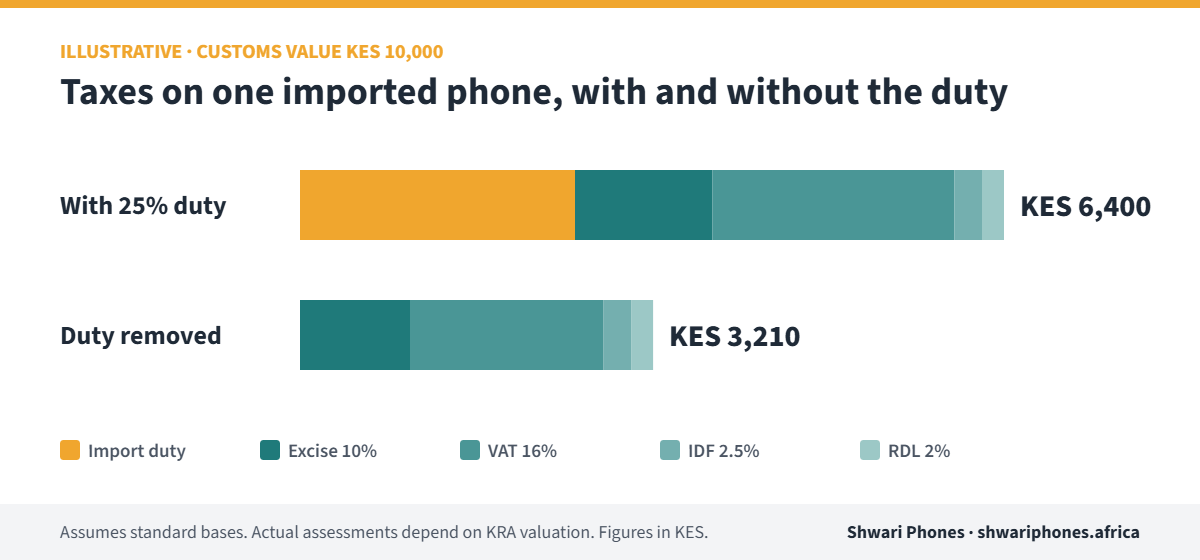
Import duty is one of five charges. In May 2026 the National Treasury listed them as 16% VAT, 10% excise duty, 25% import duty, a 2.5% Import Declaration Fee and a 2% Railway Development Levy. Treasury described the combined burden as about 55.5%, which is the sum of those rates.
Because some charges are calculated on top of others, the amount paid on the customs value is higher than the simple sum. The example below is illustrative. It assumes the standard bases: excise on customs value plus import duty, VAT on customs value plus duty plus excise, and the fee and levy on customs value.
| Phone with customs value (CIF) of KES 10,000 | With 25% duty | With duty removed |
|---|---|---|
| Import duty | 2,500 | 0 |
| Excise duty (10%) | 1,250 | 1,000 |
| VAT (16%) | 2,200 | 1,760 |
| Import Declaration Fee (2.5%) | 250 | 250 |
| Railway Development Levy (2%) | 200 | 200 |
| Total taxes | 6,400 (64%) | 3,210 (32.1%) |
| Landed cost before margin | 16,400 | 13,210 |
Shelf prices would not necessarily fall by the same amount. Retail prices also reflect exchange rates, stock bought under the old rate, and margins. Morocco’s experience, below, shows that lag.
Phone import duty in Kenya compared with the region
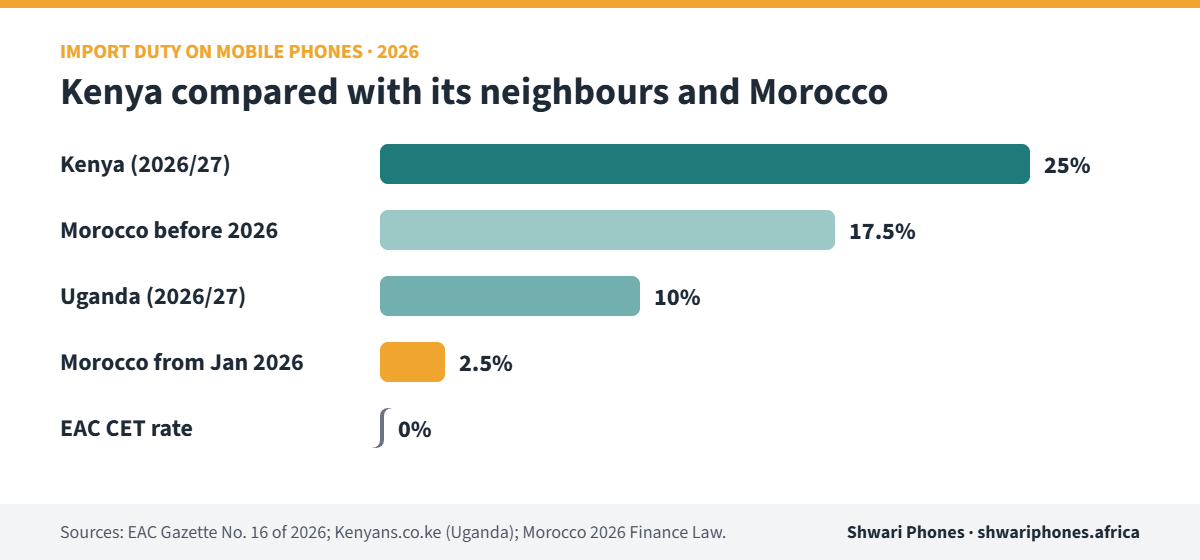
Phone import duty in Kenya is now the highest in the comparison below. The EAC’s own common rate for mobile phones is 0%, and each partner state that charges more does so through its own one-year stay.
| Market | Import duty on mobile phones | Basis |
|---|---|---|
| EAC common rate (CET) | 0% | EAC Common External Tariff |
| Kenya, 2026/27 | 25% | Stay of application, EAC Legal Notice EAC/160/2026 |
| Uganda, 2026/27 | 10% | Stay of application in the same June 2026 gazette, as reported by Kenyans.co.ke |
| Morocco, before 2026 | 17.5% | National tariff |
| Morocco, from 1 January 2026 | 2.5% | 2026 Finance Law |
Because the EAC is a customs union, a lower rate in a neighbouring state does not let Kenyan buyers avoid phone import duty in Kenya. Goods entering Kenya are assessed at Kenya’s rate.
Imported phones versus phones assembled in Kenya
Phone import duty in Kenya falls on finished handsets. Phones assembled locally are treated differently. EAC gazettes have repeatedly approved duty remission for Kenyan assemblers, letting them import specified inputs for smartphones, tablets and other smart devices at 0% for twelve months at a time.
That split is deliberate. In mid-2026, Business Daily reported that Treasury would seek duty exemption on inputs for local assembly while keeping customs duty on finished devices. The policy aim is to make assembly in Kenya cheaper than importing a finished phone.
Who pays phone import duty in Kenya
The importer pays phone import duty in Kenya to the Kenya Revenue Authority when a shipment is cleared. In practice the cost is built into the price buyers see on the shelf, together with VAT, excise duty and the two import levies.
The tariff headings do not distinguish between new and used devices. Ex-UK and refurbished phones imported into Kenya are classified under the same headings as new ones, so phone import duty in Kenya applies to them at entry too. For how those two categories differ in other ways, see ex-UK vs refurbished phones.
How to check phone import duty in Kenya yourself
- EAC Gazette. The rate is set in the EAC Gazette, usually published around 30 June each year. Search the gazette for tariff headings 8517.13.00 and 8517.14.00 and look for entries beginning “Kenya to stay the application of the EAC CET rate”.
- Mid-year notices. Any change before 30 June 2027 would also appear as an EAC Gazette notice, signed under the authority of the EAC Council of Ministers.
- KRA. The Kenya Revenue Authority applies the gazetted rate at import, so a change shows up in clearance assessments once it takes effect.
- This page. We check monthly and log every change, with the source, in the update log below.
Timeline of proposals and decisions in 2026
- May 2026: The Finance Bill 2026 proposes replacing VAT, import duty, the Import Declaration Fee and the Railway Development Levy on phones with a single 25% excise duty, charged when a phone is activated on a network. Treasury Cabinet Secretary John Mbadi describes it as a simplification, not a new tax.
- June 2026: Parliament’s Departmental Committee on Finance and National Planning rejects the activation-based excise proposal. Business Daily reports that Treasury had already stepped back from removing the 25% customs duty.
- 30 June 2026: The EAC Gazette renews the 25% duty for 2026/27.
- 20 October 2026: At Mashujaa Day in Eldoret, President Ruto says: “We will pursue the necessary legal and customs processes so that we remove the 25 per cent import duty on mobile phones.” Capital FM reports he said the proposals would go to Parliament the following week.
- 31 October 2026: KRA Board Chairperson Ndiritu Muriithi publicly defends the activation-based approach as a way to address under-declared imports.
- 24 November 2026: TechTrends Kenya reports the proposed removal has not taken effect.
- 27 November 2026: We found no EAC Gazette notice amending entry 19 of Legal Notice EAC/160/2026.
The 20 October commitment: what has to happen
Reporting on the announcement describes legal and regional customs steps. Based on how the duty was set, removal before 30 June 2027 would require the steps below. We will mark each one as it happens, with a source.
| Step | Status at 27 November 2026 |
|---|---|
| Commitment announced | Done, 20 October 2026 |
| Proposal submitted by National Treasury | No public record found |
| Decision by the EAC Council of Ministers | No public record found |
| EAC Gazette notice amending the rate | Not published |
| New rate applied by KRA at import | No, 25% still applies |
If no change is made earlier, the next routine decision point is the annual EAC Gazette due around 30 June 2027.
Comparison: Morocco’s 2026 cut
Morocco cut its import duty on mobile phones from 17.5% to 2.5% from 1 January 2026, under its 2026 Finance Law. The lower rate covers assembled phones and kits imported for local assembly. Omdia’s Q3 2026 Africa report cites it as an example of tax reform easing cost pressure.
A month after the change, Moroccan business weekly Finances News Hebdo reported that prices were falling gradually, mainly on entry-level and mid-range phones, as older stock imported at the previous rate sold through. That is the one comparison available for how a cut reaches shelves. It is not a forecast for Kenya.
Why it matters for buyers
Kenya’s smartphone shipments fell 35% in Q3 2026 and the sub-$150 segment fell 44%, according to Omdia. Because the duty covers 8517.14.00 as well as smartphones, it applies to basic feature phones too. We look at what that means at the budget end in The Kabambe Reversal, and at price movements on our own shelf in the AI Tax Index.
Phone import duty in Kenya is paid when a device enters the country. Refurbished phones in Kenya were imported and taxed when they entered the country, so any change in duty affects new stock first. If you are timing a purchase, see the cheapest iPhones in Kenya and phones under 30,000 for current prices.
Phone import duty in Kenya: frequently asked questions
What is the import duty on phones in Kenya?
25% of the customs value, on tariff headings 8517.13.00 and 8517.14.00, under EAC Legal Notice EAC/160/2026. VAT, excise duty, the Import Declaration Fee and the Railway Development Levy are charged as well.
Has the 25% phone import duty been removed?
Not as of 27 November 2026. Removal was announced on 20 October 2026, but no amending EAC Gazette notice has been published.
Was the 25% duty new in July 2026?
No. It has applied since 1 July 2024 and was renewed in June 2025 and June 2026. The “0%” in many reports is the EAC CET rate that Kenya’s stay replaces.
Does the duty apply to feature phones?
Yes. Heading 8517.14.00 covers mobile phones other than smartphones, which includes feature phones.
Is the 25% excise duty on activation in force?
No. It was proposed in the Finance Bill 2026 and rejected by Parliament’s finance committee.
How often is this page updated?
Monthly, and whenever a gazette notice, Treasury statement or KRA notice changes the position. Each update is logged below.
Who sets phone import duty in Kenya?
The EAC Council of Ministers approves it, on Kenya’s request, as a one-year stay of the common tariff. The National Treasury proposes the rate and the decision is published in the EAC Gazette.
Does phone import duty in Kenya apply to refurbished phones?
Yes. Refurbished and ex-UK phones are imported under the same tariff headings as new phones, so they pay the duty when they enter Kenya.
Is phone import duty in Kenya the same as excise duty?
No. Import duty is a customs charge set through the EAC. Excise duty is a separate 10% domestic tax on imported cellular phones under Kenya’s Excise Duty Act. Both are charged on the same phone.
When does the current phone import duty in Kenya expire?
The current stay runs for one year from 1 July 2026, so it ends on 30 June 2027 unless it is amended earlier. Kenya has asked for, and received, a renewal each June since 2024. Whether it asks again in 2027 is the next decision point this tracker will record.
Would removing the duty make every phone cheaper?
It would lower the tax on new imports, but not overnight and not by the same amount on every model. Retailers price stock they already hold at what it cost them, exchange rates move, and margins differ by brand. Morocco’s experience after its January 2026 cut was a gradual fall, mainly on entry-level and mid-range phones. Phones that are already in Kenya, including refurbished stock, have already paid phone import duty in Kenya, so a cut would reach them only as new stock arrives.
Update log
- 27 November 2026: Page published. Rate 25%. Removal announced, not in effect.
Journalists, tax practitioners and researchers are welcome to cite this tracker. If you spot an error or a newer notice, tell us through the contact details on our homepage and we will correct it and log the change.
Sources
- EAC Gazette Vol. AT 1 No. 16, 30 June 2026 (Legal Notice EAC/160/2026)
- EAC Gazette Vol. AT 1 No. 19, 30 June 2025 (Legal Notice EAC/171/2025)
- Bowmans: new customs duty rates, July 2024
- The Star: Treasury on the phone tax framework (26 May 2026)
- Business Daily: MPs reject activation excise
- Kenyans.co.ke: 20 October announcement
- Capital FM: proposed duty removal
- People Daily: KRA chair on activation-based tax
- TechTrends Kenya: status at 24 November
- Omdia: Africa smartphone shipments, Q3 2026
- Morocco 2026 Finance Law: phone duty 17.5% to 2.5%
- Finances News Hebdo: Moroccan prices after the cut