
Phone Prices in Kenya 2026: The AI Tax, Model by Model
Article

Steve Owako
Shwari Phones
Last updated: 25 November 2026
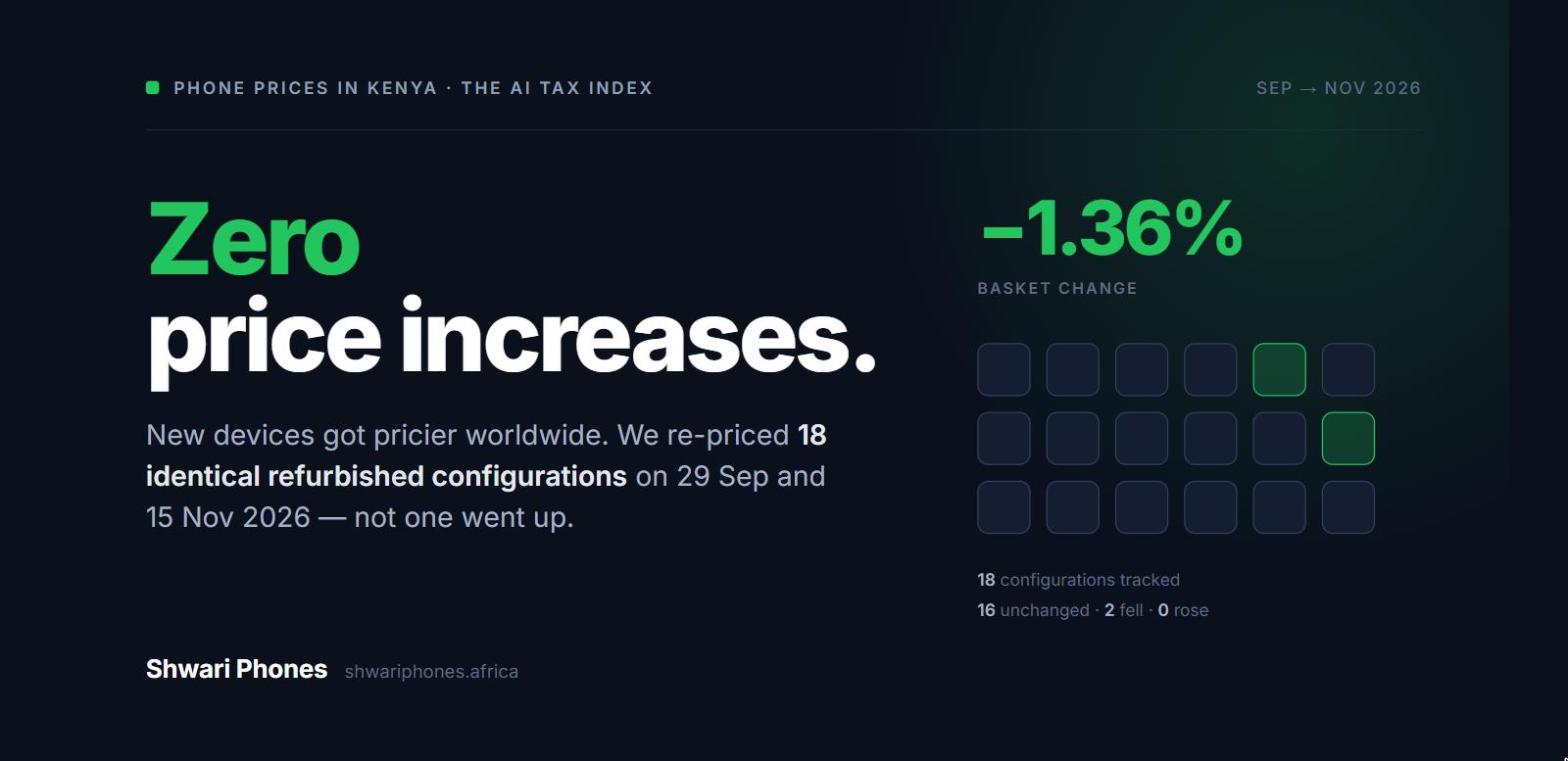
Phone prices in Kenya rose across almost every new device in 2026, but not everywhere. We priced 18 identical refurbished flagship configurations on 29 September 2026 and again on 15 November 2026, both published on this blog at the time. Not one of them went up. Sixteen were unchanged, two fell, and the basket as a whole moved −1.36%. Over the same stretch, new smartphone prices worldwide climbed by double digits.
This page is the Shwari AI Tax Index: a running record of what phone prices in Kenya actually do, in shillings, while the global memory shortage reprices the rest of the industry.
On this page
- The headline numbers
- The index: 18 configurations, two dates
- Why refurbished prices did not move
- What happened to the cost of memory
- What the memory shortage cost Kenya
- The two-speed market: new versus refurbished
- What a gigabyte costs on a Kenyan shelf
- What this means if you are buying
- Method and sources
- Frequently asked questions
The headline numbers
- 18 identical configurations tracked, 29 Sep → 15 Nov 2026
- 0 price increases
- 16 unchanged, 2 reduced
- Basket value: KES 882,000 → KES 870,000 (−1.36%)
- Excluding the one Black Friday markdown: −0.25%, effectively flat
- Storage pricing: KES 39 per extra gigabyte, median, unchanged in both snapshots
Phone prices in Kenya: the index, 18 configurations, two dates
Every figure below comes from our own published price lists. Both source posts are still live and dated, so anyone can check them.
| Model | Config | 29 Sep 2026 | 15 Nov 2026 | Change |
|---|---|---|---|---|
| Galaxy S20 FE | 6/128GB | 22,500 | 22,500 | 0% |
| Galaxy S21 FE | 8/128GB | 27,000 | 25,000 | −7.4% |
| Galaxy S21 | 8/128GB | 28,500 | 28,500 | 0% |
| Galaxy S22 | 8/128GB | 30,000 | 30,000 | 0% |
| Galaxy S21 Plus | 8/128GB | 32,000 | 32,000 | 0% |
| Galaxy S20 | 8/128GB | 35,000 | 35,000 | 0% |
| Galaxy S22 Plus | 8/128GB | 35,000 | 35,000 | 0% |
| Galaxy S21 Ultra | 12/128GB | 38,000 | 38,000 | 0% |
| Galaxy S23 | 8/128GB | 38,000 | 38,000 | 0% |
| Galaxy S22 Ultra | 8/128GB | 45,000 | 45,000 | 0% |
| Galaxy S23 Plus | 256GB | 48,000 | 48,000 | 0% |
| Galaxy S24 | 8/128GB | 50,000 | 50,000 | 0% |
| Galaxy S25 | 12/128GB | 58,000 | 58,000 | 0% |
| Galaxy S23 Ultra | 8/256GB | 65,000 | 65,000 | 0% |
| Galaxy S24 Plus | 256GB | 65,000 | 65,000 | 0% |
| Galaxy S25 Plus | 256GB | 70,000 | 70,000 | 0% |
| Galaxy S24 Ultra | 12/256GB | 90,000 | 80,000 | −11.1% |
| Galaxy S25 Ultra | 12/256GB | 105,000 | 105,000 | 0% |
Two honest caveats. Seven weeks is a short window, and the 15 November snapshot sits inside our Black Friday Samsung pricing, which pulls the basket down slightly. Strip the discounted S24 Ultra out and the remaining 17 configurations moved −0.25%. The finding is stability, not a bargain.
Why refurbished prices did not move
The reason phone prices in Kenya held on the refurbished shelf is simple once you see it, and it is the whole argument of this page: the memory inside a refurbished phone was bought years ago.
The 8GB of RAM in a Galaxy S21 was manufactured and paid for in 2021. The 128GB of storage in an iPhone 13 was bought in 2021 too. Whatever happens to chip contract prices in 2026, nobody can go back and re-charge for silicon that is already soldered into a handset that has already been sold once. The second-hand channel is the only part of the phone industry operating on a pre-AI cost basis.
New phones have no such shelter, which is why phone prices in Kenya diverged so sharply by channel this year. Every unit coming off a production line this quarter buys its memory at today’s prices, and today’s prices are extraordinary.
What happened to the cost of memory
The pressure on phone prices in Kenya starts a long way from Nairobi. AI data centre construction absorbed the world’s memory supply. Manufacturers shifted production toward high-bandwidth memory for AI accelerators, starving the conventional DRAM and NAND that phones use.
- A gigabyte of mobile memory cost about $2.80 in 2025. By mid-2026 it was roughly $12, according to ChannelLife’s RAMaggedon analysis.
- DRAM prices reached more than ten times their January 2025 level in some cases, Bloomberg reported.
- For phones under $200, the bill of materials rose 20% to 30% in a single year, per Counterpoint Research via CNBC.
- Gartner put the combined DRAM and SSD surge at 130% by end-2026, feeding through to roughly 13% on smartphone prices.
- New phones were 13% more expensive in Q2 2026 than Q1, and global shipments fell.
The industry nickname for this is RAMaggedon, and the company at the centre of the demand is NVIDIA, whose AI systems created the appetite for memory in the first place. Its co-founder resigned in November 2026 and was reinstated within a fortnight. The chip economics he set in motion did not pause for any of it.
What the memory shortage cost Kenya
Kenya absorbed this worse than most of the continent. Kenyan smartphone shipments fell 15% year-on-year in Q2 2026, a steeper drop than the African average, with the damage concentrated in the sub-$150 segment where most buyers actually shop. Across Africa, 2026 shipments are forecast to fall 26%.
The casualty is the cheap phone. Of all the shifts in phone prices in Kenya this year, this is the one that reached the most people. The old 10,000-shilling smartphone bracket has effectively disappeared, because the memory alone now costs more than that bracket’s entire old margin allowed.
There is a second Kenyan angle, and it is a strange one. The same company behind the memory squeeze is building here: an NVIDIA-powered AI factory in Kenya is planned to run 12,000 GPUs, part of a roughly $700 million partnership with Cassava Technologies spanning South Africa, Nigeria, Kenya, Egypt and Morocco. Kenya is set to host some of the compute that made its own phones more expensive.
The two-speed market: new versus refurbished
The useful way to read phone prices in Kenya in 2026 is to stop treating them as one market. There are two, and they are moving in opposite directions.
On the new side, every handset carries this quarter’s memory cost. Manufacturers have responded in two ways: raising prices outright, or holding the price and quietly cutting the specification. The industry calls the second one shrinkflation, and it is the harder one for buyers to spot, because the model name on the box does not change. A 2026 variant with 6GB of RAM where last year’s had 8GB is a price rise disguised as continuity.
On the refurbished side, the specification is fixed and already paid for. An ex-UK Galaxy S23 has the 8GB it shipped with in 2023, and no supply shock can reach back and change that. This is why phone prices in Kenya now depend less on which model you choose than on which of the two markets you buy it in.
The practical consequence is that comparing a new handset to a refurbished one on price alone understates the gap. You also have to check what each one contains. On the refurbished shelf the specification is a matter of record; on the new shelf, in 2026, it is worth verifying.
We will keep adding snapshots to this index as we publish new price lists, so the record of phone prices in Kenya gets longer and more useful over time rather than becoming a single frozen claim.
What a gigabyte costs on a Kenyan shelf
We also measured the storage premium, the amount a buyer pays to move up one tier on the same handset. Across 15 model pairs, the median was KES 39 per gigabyte, with a modal step of KES 5,000 for an extra 128GB.
| Handset | Step | Price gap | KES / GB |
|---|---|---|---|
| Galaxy S22 | 128 → 256GB | 5,000 | 39 |
| Galaxy S23 | 128 → 256GB | 5,000 | 39 |
| Galaxy S24 | 128 → 256GB | 5,000 | 39 |
| Galaxy S25 Ultra | 256 → 512GB | 5,000 | 20 |
| iPhone 13 | 128 → 256GB | 6,500 | 51 |
| iPhone 14 | 128 → 256GB | 5,500 | 43 |
| iPhone 15 Pro | 128 → 256GB | 5,000 | 39 |
| iPhone 16 Pro | 128 → 256GB | 5,000 | 39 |
That figure did not change between our two snapshots either. On a new device, the same upgrade is where manufacturers now recover their memory costs most aggressively.
What this means if you are buying
Three practical conclusions about phone prices in Kenya, and one of them argues against spending more with us.
Storage is the upgrade to take now. Of every decision in front of you, this is the one where phone prices in Kenya are most likely to move against you later. At KES 39 per gigabyte, a 256GB variant is the cheapest insurance on this page. If the shortage persists into 2027 as analysts expect, that premium is the first thing to rise.
The spread is widening, not narrowing. Each quarter that new prices climb while refurbished holds, the gap for the same handset grows. That favours buying refurbished, but it also means refurbished stock itself gets scarcer, and global refurbished demand is forecast to grow around 11% year-on-year. Supply of clean ex-UK stock is finite.
Do not rush a flagship you do not need. If your current phone works, the index says you are not losing money by waiting on the refurbished side. Prices here are not climbing. That is the honest read, and it is the opposite of what a Black Friday banner would tell you.
If you are buying, our guide to ex-UK versus refurbished phones explains what the grades actually mean, phones under 30,000 covers the budget end, and Lipa Pole Pole and trade-in options cover paying over time. Current pricing sits on the Samsung S series price list, the cheapest iPhone in Kenya breakdown and the Galaxy Fold price page. If you have not bought from us before, how to check we are legitimate is a fair place to start.
Method and sources
This record of phone prices in Kenya compares two price lists published on this blog, on 29 September 2026 and 15 November 2026. We included only configurations appearing in both with an identical RAM and storage specification, giving 18 matched pairs. Prices are our own retail asking prices in Kenya shillings for Grade A refurbished stock with a 6-month warranty, not market averages. The basket figure is unweighted by sales volume. Storage premiums were calculated from same-handset tier pairs in the November list.
Journalists, researchers and other retailers are welcome to cite these phone prices in Kenya and reuse the data with attribution and a link to this page. We update the index as new price lists are published.
Phone prices in Kenya: frequently asked questions
Why are phone prices in Kenya rising in 2026?
Because AI data centres absorbed the world’s memory chip supply. Manufacturers moved capacity to high-bandwidth memory for AI accelerators, which drove conventional DRAM and NAND prices sharply higher. Memory is a large share of a phone’s bill of materials, so the increase passed through to retail. Kenyan buyers also face currency movement and local taxes on top.
Did refurbished phone prices rise too?
Not in our data. Across 18 identical configurations between late September and mid-November 2026, none rose, 16 held and two fell. The memory in a refurbished handset was purchased years ago, so current chip prices cannot be applied to it retroactively.
Will phone prices in Kenya come down in 2027?
Analysts do not expect the memory shortage to resolve quickly, and some suppliers have warned it could persist for years. On that basis new-phone prices are more likely to stay elevated than to fall. We make no forecast about our own prices beyond what the index records.
Are refurbished phone prices in Kenya a reasonable way to avoid the increase?
It is the clearest route available in Kenya right now, which is why demand for refurbished devices is growing globally. The trade-off is that supply is limited and strong demand is firming up wholesale prices, so the advantage may narrow over time.
What is the AI Tax Index?
It is our name for this tracker of phone prices in Kenya: the gap between what the global memory shortage has done to new phone prices and what has actually happened to phone prices in Kenya on the refurbished shelf.