
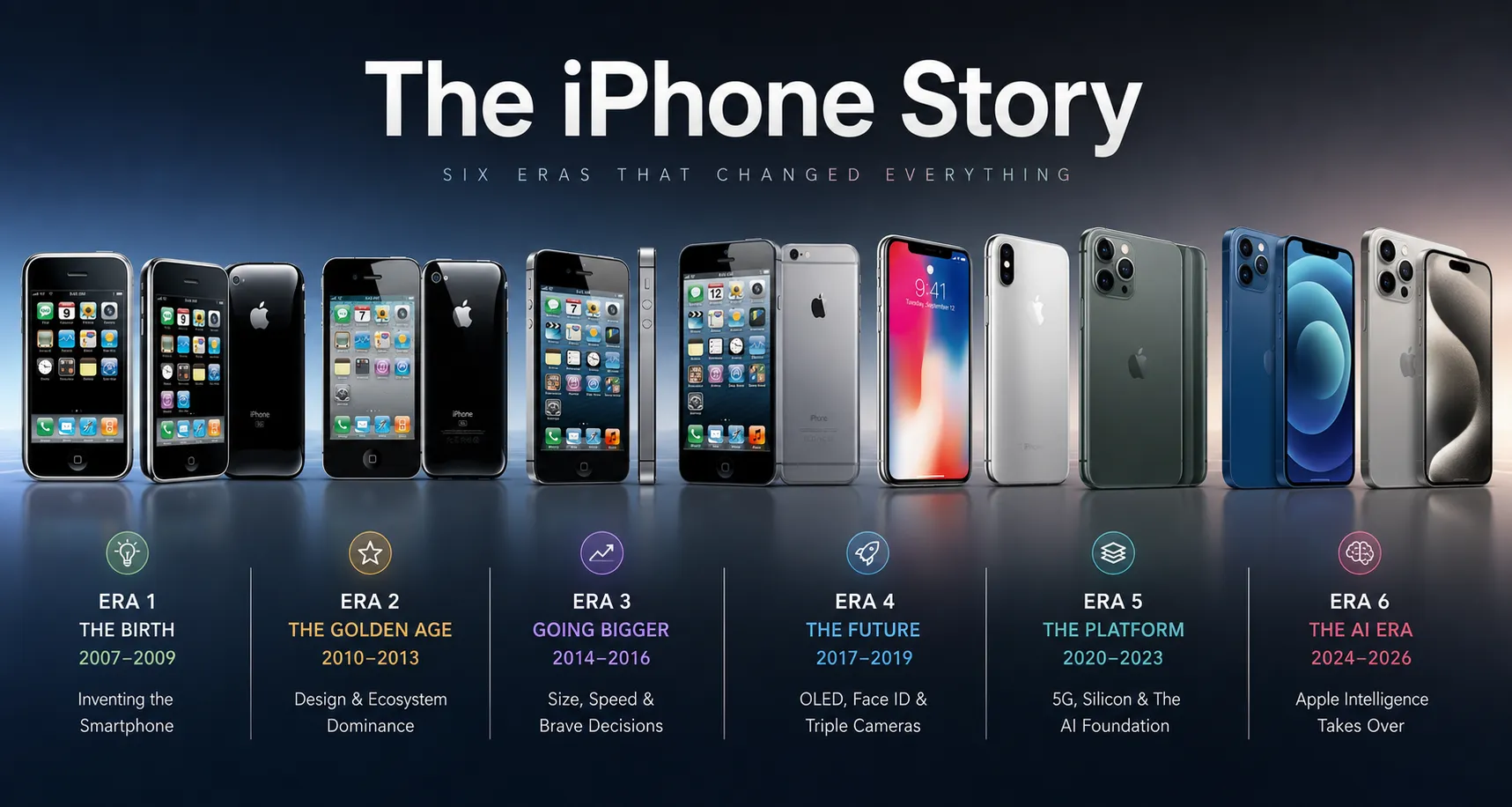
The iPhone Story: Six Eras That Changed Everything
Article

Lewis Okwara
Shwari Phones
Last updated: 30 May 2026
Few products have reshaped the world as completely as the iPhone. What started as a single touchscreen device with no App Store has grown into a global platform with over a billion active users. This is the story of how Apple's most important product evolved, grouped into the six defining eras that tell its remarkable journey from 2007 to today.


Era 1: The Birth 2007–2009
INVENTING THE SMARTPHONE
Before 2007, phones were phones. Then Steve Jobs walked onto a stage and introduced three products in one: a widescreen iPod, a revolutionary phone, and an internet communicator. The original iPhone had no App Store, no 3G, and no copy-paste — but it rewrote the rules of an entire industry overnight. The 3G (2008) added the App Store and unleashed a developer ecosystem that changed software forever. The 3GS (2009) brought video recording and raw speed, proving Apple could iterate fast. Three phones. Three years. A category invented from scratch.
Defining Firsts
- Multi-touch capacitive display — no stylus, no buttons
- App Store launch (2008) — 500 apps on day one, millions within months
- Video recording debuts on the 3GS (2009)
- GPS navigation in your pocket

🏆 GAME CHANGER: iPhone (2007) — It didn't improve the smartphone — it invented it.
Era 2: The Golden Age 2010–2013
DESIGN & ECOSYSTEM DOMINANCE
This era produced arguably the most iconic iPhone design ever — the flat glass and stainless steel iPhone 4 — and Apple's sharpest display to date: the Retina screen. FaceTime made video calling mainstream. The 4S brought Siri, introducing the world to AI assistants on smartphones. The iPhone 5 stretched to four inches, swapped in Apple's first fully custom chip (the A6), and introduced the Lightning connector that would last a decade. This was Apple at peak design confidence — setting visual and engineering standards the rest of the industry chased for years.

Defining Firsts
- Retina display — 326ppi, sharpest screen on any phone at the time
- Siri — the first mainstream AI voice assistant (2011)
- Touch ID fingerprint sensor (iPhone 5s, 2013)
- 64-bit mobile chip — Apple A7, years ahead of the competition (2013)
- LTE connectivity — truly fast mobile data arrives (2012)

🏆 GAME CHANGER: iPhone 4 (2010) — The Retina display and iconic flat-glass design set the visual standard for a decade.
Era 3: Going Bigger 2014–2016
SIZE, SPEED & BRAVE DECISIONS
Apple spent years insisting one-handed use was the ideal. Then the iPhone 6 arrived with a 4.7-inch display and a 5.5-inch Plus model — and immediately became the best-selling iPhone in history. The market had been right all along. This era also saw Apple make two controversial calls that proved visionary: removing the headphone jack (iPhone 7) and adding a second camera (iPhone 7 Plus). Portrait Mode — depth-of-field blur from a phone — landed like a bombshell. Apple Pay debuted with NFC. The A10 Fusion introduced the hybrid performance/efficiency core architecture that Apple Silicon still uses today.

Defining Firsts
- 4.7-inch and 5.5-inch displays — Apple finally goes big (2014)
- Apple Pay with NFC — tap-to-pay from your phone (2014)
- Dual camera system + Portrait Mode (iPhone 7 Plus, 2016)
- Headphone jack removed — Lightning-only audio (2016)
- IP67 water resistance arrives (2016)
- A10 Fusion: first performance/efficiency hybrid cores

🏆 GAME CHANGER: iPhone 6 (2014) — Apple admitting the market was right — and it became the best-selling iPhone ever at the time.
Era 4: The Future 2017–2019
OLED, FACE ID & TRIPLE CAMERAS

The iPhone X was a reset. Apple tore up ten years of its own design language — gone was the home button, gone was Touch ID, gone was the thick top and bottom bezel. In came an edge-to-edge OLED display, Face ID using a 3D TrueDepth camera, and the Neural Engine: Apple's first dedicated AI chip. It cost $999 and instantly felt like a device from five years ahead. The XS and XR refined the formula, and the iPhone 11 Pro went to three cameras — wide, ultra-wide, and telephoto — while Night Mode made low-light photography extraordinary. Every iPhone made after 2017 is a descendant of the X.

Defining Firsts
- Edge-to-edge OLED display — no home button (iPhone X, 2017)
- Face ID — 3D facial recognition replaces Touch ID (2017)
- Neural Engine — Apple's first dedicated AI processor (2017)
- Wireless Qi charging (2017)
- Triple camera system — wide + ultra-wide + telephoto (2019)
- Night Mode — low-light photography transformed (2019)

🏆 GAME CHANGER: iPhone X (2017) — The single biggest reinvention in iPhone history. Everything since is built on its blueprint.
Era 5: The Platform 2020–2023
5G, SILICON & THE AI FOUNDATION
This era was about building the infrastructure for what comes next. The iPhone 12 brought 5G to all models and brought back the beloved flat-edge design. MagSafe returned as a magnetic wireless ecosystem. The A14 through A17 chips, all built on ever-shrinking processes (5nm down to 3nm), gave Apple a silicon lead over every Android competitor. The iPhone 13 Pro's ProMotion 120Hz display raised the smoothness bar. The iPhone 14 introduced Emergency SOS via Satellite — a genuine lifesaver. The Dynamic Island replaced the notch and became the most creative piece of phone UI in years. USB-C finally replaced Lightning in 2023, and titanium frames arrived on the Pro.

Defining Firsts
- 5G on all models + MagSafe magnetic ecosystem (2020)
- 120Hz ProMotion adaptive display on Pro (2021)
- Dynamic Island — notch replaced with interactive UI (2022)
- Emergency SOS via Satellite — connectivity without cell coverage (2022)
- USB-C replaces Lightning after 11 years (2023)
- Titanium frame on Pro — lighter and stronger than steel (2023)
- 48MP main camera — first major megapixel jump since 2015 (2022)

🏆 GAME CHANGER: iPhone 12 (2020) — 5G for everyone, MagSafe reborn, and a design reset that made the iPhone feel new again.
Era 6: The AI Era 2024–2026
APPLE INTELLIGENCE TAKES OVER
The iPhone 16 series was Apple's clearest statement yet: AI is the new frontier. Apple Intelligence brought on-device writing tools, image generation, a dramatically smarter Siri, and more — all processed locally without sending data to the cloud. The Camera Control button gave every model a dedicated hardware shutter. The iPhone 17 Air revived the ultra-slim form factor. And if the iPhone 18 rumours hold — a 2nm A20 Pro chip, variable aperture camera, and the long-awaited foldable iPhone — Apple is still only getting started.

Defining Firsts
- Apple Intelligence — on-device AI across writing, images & Siri (2024)
- Camera Control hardware button on all models (2024)
- iPhone 17 Air — thinnest iPhone ever (2025)
- A20 Pro on 2nm — 15% faster, 30% more efficient (2026, rumoured)
- Variable aperture camera — a first for any iPhone (2026, rumoured)
- Foldable iPhone — the long-awaited form factor (2026, rumoured)

🏆 GAME CHANGER: iPhone 16 (2024) — The moment AI stopped being a feature and became the entire product strategy.
So What Does It All Mean?

Nineteen years. Six eras. One throughline: Apple never coasts for long. Every time the iPhone felt settled, it blew up its own formula — removing the home button, adding cameras nobody asked for, killing the headphone jack, shrinking the chip process, going all-in on AI. The iPhone's greatest trait isn't any single feature. It's the willingness to make itself obsolete before anyone else can.

The next era is already taking shape. And if history is any guide, it'll surprise us.
Note: iPhone 18 (2026) details are based on leaks and rumours and have not been officially confirmed by Apple.